Monday, June 20, 2016

Monte Alban


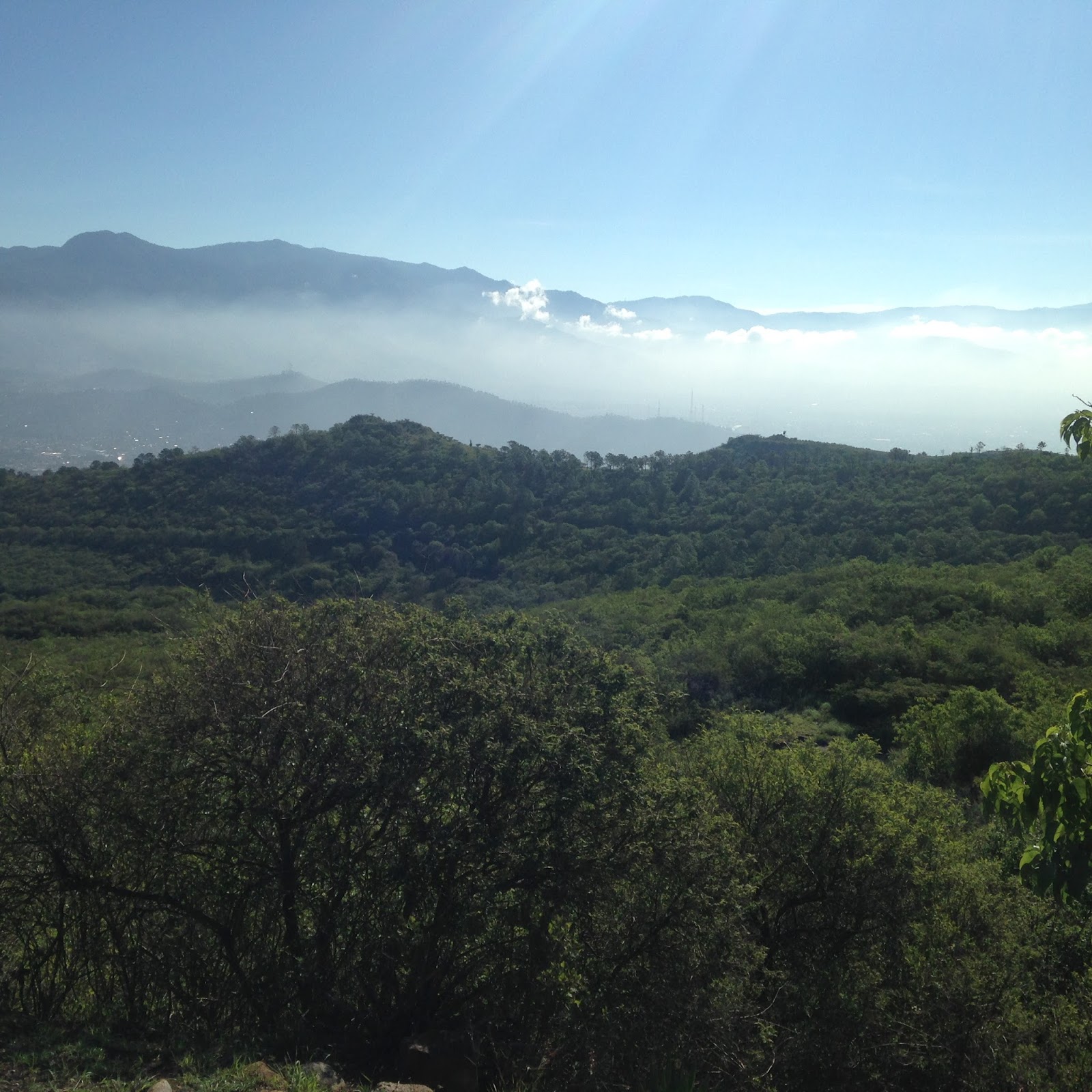
It is believed the Zapotecs chose the top of the Monte Alban to build there temples because they felt closest to the gods from that height. You would think knowing that fact I would have been a little more prepared for the rigor of the climb, but alas I was not. While some of you may be thinking, “Awesome, hiking is so fun! I bet you had a great experience!” allow me to put some qualifiers on the situation.  Monte Alban is a very large, very steep mountain and the majority of tourists take a bus to get to the top. My class and I hiked the path the way the indigenous population do when they visit the ruins. I was told the natives of the area can climb to the top in thirty minutes, but it took my class about an hour and a half! Our tour guide, Jose, a native to the region told us we would be a little slower because our bodies aren’t used to the altitude or the heat, but I think he was just being kind. I highly recommend to anyone planning to hike Monte Alban that you try to get in shape before you go, because it’s not an easy hike by a long shot. Even though the path is worn from thousands of years of use, the terrain is still rocky and littered with cacti and spiky underbrush. I basically looked down the entire time to ensure my steps were identical to the person in front of me so I didn’t slip. However for all of my complaining the view from the top is phenomenal.

In addition to the view, also at the top is the Monte Alban Archaeological Ruins On Site Museum, which contains replicas of some of the original stones used in the building of the temples and other artifacts, including skulls that prove the ancient Zapotecs practiced an early form of neurosurgery! What is really cool about the museum is that they allow you to walk the ruins, including climb the pyramids! Climbing the pyramids is more difficult than one would think. The stairs are really far apart from each other, which makes walking down even more challenging. My professor recommended walking in a zigzag pattern to lessen the impact and disorientation, our tour guide said the stairs were designed like that so no one would be directly facing the gods. Nonetheless the site from the top of the pyramid is even more amazing than the site from the top of mountain. At Monte Alban I constantly found myself thinking, “just when you can’t think the view gets any better it does!” After an hour or so of walking around exploring the ruins, we headed back down the mountain which was slightly easier, except I really had to watch my footing so I didn’t fall. 
Monte Alban really challenged me physically, but it gave me a greater appreciation for the outdoors and it inspired me to try hiking when I return to the states.


Me after at the top of one of the pyramids


**Fun Fact: The ancient Zapotecs flattened the entire mountaintop with only their hands and small hand-held tools, and the entire length of the mountain is probably the length of twenty NFL stadiums. 


Sunday, June 19, 2016

EcoAlebrijes in Arrazola


This past weekend my class and I traveled to Arrazola, and spent the night in rural Oaxaca at the hospitality of members of the Ecoalebrije Project. The Ecoalebrije Project is similar to the weaving cooperative in Teotitlan, except their specialty isn’t weavings, but traditional Oaxacan wooden carvings called alebrijes. These figurines range from being very tiny decorative pieces to large statement pieces. While the alebrijes are indigenous to Oaxaca, in Arrazola, the people in the Ecoalebrije coalition only carve their figurines from copal wood. It is said that the EcoAlebrije artist studies the branch until he sees a shape or form emerging from the wood, then carves a figurines from a branch of the soft copal wood. EcoAlebrije artisans strive to use all the wood that is cut from the tree in an attempt to be conservative with their resources.

Street near my homestay in Arrazola. Building with the cross on it is the bathroom.
Not only do the members of EcoAlebrijes strive to be eco-friendly with their crafts, and ensure the stability of the copal tree but they also are committed to environmental sustainability in their community. Some of the community work the members of EcoAlebrijes contribute to in Arrazola include:
·          1. Clearing litter and removing the ubiquitous plastic particles from the soil
·      2. Composting
·      3. Moving prepared dirt and compost to various staging area
·      4. Making and preparing containers for copal seedlings
·      5. Nurturing, planting, and tending copal seedlings
·      6. Transplanting rooted seedlings to hillside
·      7. Tending to the developing copal orchard.

 During our stay time in Arrazola my class helped uproot trees and replant them, as well as paint limestone on the trunks to prevent insects from biting and damaging the wood. Afterwards the artisans taught us how to paint our own alebrijes!
Armadillo alebrijes
Elephant alebrije
I think a very common ethnocentric American perspective, that I myself held previous to this experience, is that people in developing world, have enough to worry about like clean water and control of infectious disease that they don’t care about “luxuries” like recycling and the impact their actions have on the environment. How wrong was I! In my time in Mexico I’ve seen so many signs of environmental awareness aside from the EcoAlebrije project. For example in most buildings there are three trashcans, one for recycling plastics, one for organic material like fruit and nuts, and one for paper products. I have also noticed that no one uses paper towels, both in private and public restrooms people use cotton towels. It’s very interesting to me, that a country that is not considered first world, sees the importance in environmental protection even when the “enlightened” and at times patronizing U.S. still struggles with getting their citizens to recognize the value in eco-friendly solutions.
 
My homestay for my time in Arrazola

Front yard of my homestay in Arrazola


Saturday, June 11, 2016

Vida Nueva: A Zapotec Women's Weaving Cooperative


This weekend we traveled to Teotitlan del Valle, the people in this area are known for their beautiful tapestries and woven textiles, made with all natural dyes. I have seen many of these tapestries sold in the Centro, so it was really cool to learn the history behind the designs and meet the ancestors of the people who created them.  In the past, the weavers of Teotitlan would sell their tapestries and smaller weavings to large corporations in Oaxaca City, who would sell the tapestries in the market, but only give a portion of the sale to the weavers. As technology advanced, and Teotitlan was less cut off from the market economy they realized they were being swindled, and several families began starting cooperatives in which they would share supplies and profit.
My class and I were fortunate enough to be hosted by one of these cooperatives. Vida Nueva, a Zapotec1 women’s weaving cooperative has a very rich history and an interesting story that one of the women was able to recount us with during our time their. The cooperative was started around twenty years ago by some of the widowed older women in their community who needed to support themselves. This was controversial at the time because twenty years ago in rural Mexico a women’s place was inside the home. Everyone in a weaving family plays a role, but men were responsible for handling accounts outside the home such as negotiating sales to vendors. However the women who started the cooperative took the initiative to try and determine if their interests could be better served. At first it was just a few older women discussing the weaving politics together once or twice a week without any type of formal organization, but after a few meetings they decided to get organized and get patent rights to increase their profit from sales.
Overview of the main area of Vida Nueva
I was blow away learning about the entrepreneurship and quite frankly gall of these ladies in a time where women in their position didn’t have a voice. I’m not the only one intrigued by their movement. Lynn Stephen a professor of Anthropology at the University of Oregon wrote the book Zapotec Women: Gender, Class, and Ethnicity in Globalized Oaxaca in which she discusses about how the cooperative has strived to “gain political and cultural rights within their community and standing as independent artisans within the global market.”
Spools of dyed wool drying

After a delicious lunch of Mole2 Negro with chicken and rice, the women were kind enough to show us how they make their natural dyes. Essentially wool ranges from white to grayish, and depending on the wool color, when dye is added different colors can be produced.  Aforementioned all the dyes are natural. They use indigo for blue, and different kinds of nuts for brown, but red is interesting. They use cochineal, which is a little white bug that lives on cacti. When the bug is crushed it produces this brilliant fine red powder. The weavers can change the intensity of the dye by allowing colors to sit longer in water, and can add lemon juice or other additives to change the color altogether. 


The natural dye materials
Cochineal bugs attached to cactus

One of the women showing us how the weaving
machine works.
Sample of the changes that can occur when lemon
 juice or charcoalis added to red cochineal dye.
I had a great time in Teotitlan, and I learned so much about the women at Vida Nueva. I think my biggest take away though, is that the world needs to do a better job of supporting global artisans especially in Central and South America. As the world becomes increasingly more connected, it is easier for designs to be copied, and sold by people who did not create them for profit. Looking forward I think it is important to be more aware of where things come from when we make purchases in order to allow local Oaxacan artisans the ability to continue their tradition.
My class and some of the women in Vida Nueva

1Zapotecs are one of the three indigenous Natives of Oaxaca (pre-Spanish colonization).

2Mole is this thick sauce that is indigenous to Oaxaca. There are seven. Negro, Rojo, Verde , Coloradito, Amarillo, Chichilo, Manchamantel. Mole negro is made with cacao, so it tastes a little like chocolate. It sounds weird that it is eaten with chicken and rice, but somehow it works for me at least!
My favorite tapestry


A sample of some of the weavings